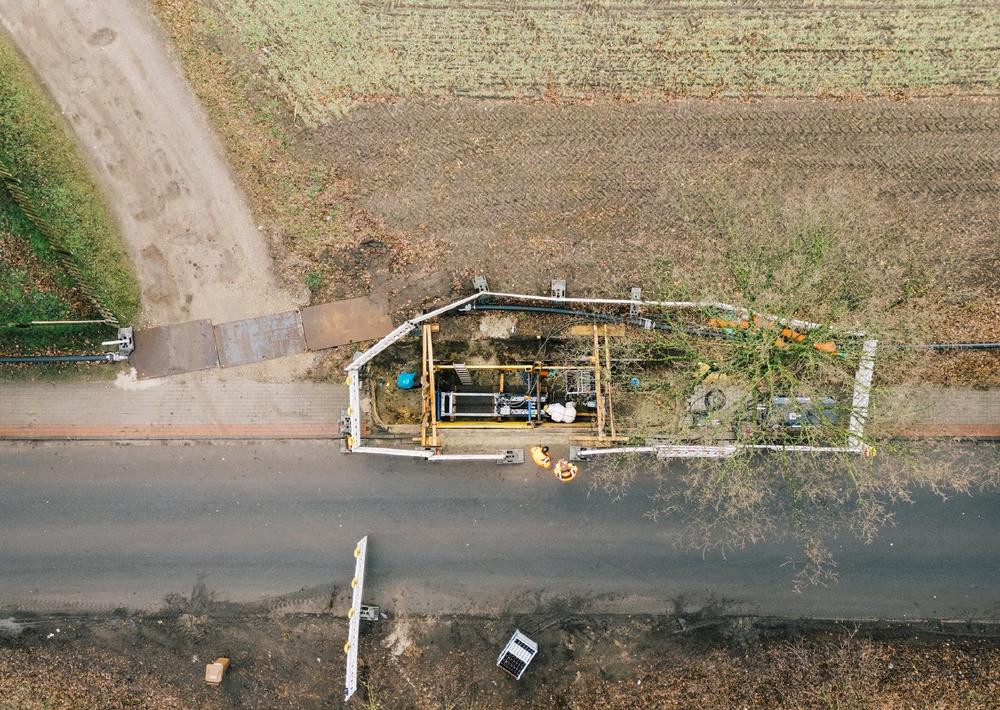
Urgent need for rehabilitation worldwide
The rehabilitation of underground infrastructure is an urgent issue for many municipal and private-sector utility and waste management companies. Studies suggest that in Germany alone, around 20% of the water infrastructure is in need of rehabilitation, yet only around 1% of the total network is rehabilitated each year. To improve the condition of the water network sustainably, around 120,000 kilometres of network would need to be rehabilitated in the short and medium term. There is also an enormous need for rehabilitation in sewage networks, as 19% of sewers in Germany show severe damage. This means that 114,000 km of sewers must be rehabilitated as soon as possible. Based on external assessments, the global rehabilitation market is estimated at around €5 billion. These figures highlight the significant demand for the appropriate technology and expertise required for the sustainable repair of pipelines.
Trenchless methods make networks fit for the future
Cracks, spalling, misaligned joints, deformations, root ingrowth or general leaks: when sewer and pipe networks reach the end of their service life, action must be taken. Whilst open-trench rehabilitation is usually impractical and repair methods only provide a temporary fix, trenchless pipe renewal offers the most sustainable and gentle solution to make ageing and damaged networks of all kinds fit for the future in the long term. After all, trenchless’ does not just mean significant savings in time, resources and costs compared to open-trench construction. Pipe rehabilitation using the pipe bursting method means a new pipe in the existing route with a service life of 80–100 years under perfect structural conditions and without any follow-up costs.
The pipe bursting method enables capacity expansion
The pipe bursting method has proven its worth worldwide for decades and is as simple as it is ingenious: the old pipe is broken up and forced radially into the surrounding soil, whilst the new pipe is pulled into the cleared cross-section in the same operation. By installing new pipes with a larger diameter, the hydraulic capacity of the pipeline can also be increased in a single operation. This advantage is particularly significant for existing pipe networks that have reached their capacity limits. The static bursting method is suitable for in-situ renewal of pipes from DN 50 to 1,200 and can be used from/to a manhole and/or pit.
Practical expert knowledge for the rehabilitation sector
To build greater expertise in trenchless pipe renewal, the full-service provider TRACTO is pooling its decades of expertise in the ‘Pipe Bursting Center’, which brings together technology, practical application and project knowledge. The PBC’s experts share their knowledge through demonstrations, presentations and training courses, advise construction companies on process selection and system design, or support the often highly bespoke
rehabilitation projects from planning through to implementation if required. Another key focus of the PBC is to further develop the growing market for pipe bursting technology and to optimise the product portfolio so that TRACTO is well-equipped as a solutions provider for the future challenges in pipe rehabilitation.
New TIP insertion unit for pipe-in-pipe renewal
At IFAT, TRACTO is showcasing a new insertion unit for pipe-in-pipe renewal using the TIP method (= Tight-In-Pipe), presenting another sustainable solution for trenchless pipe rehabilitation. The principle is remarkably simple: starting from a launch shaft, the new pipes are inserted one by one into the defective old pipe using hydraulic cylinders. A calibration head compensates for any existing deformations and restores the circular cross-section during installation – regardless of the geometric condition of the old pipe. The new pipe fits tightly against the old pipe; the resulting minimal annular gap does not need to be filled. The result is a structurally self-supporting, tested new pipeline with a long service life – installed using a minimally invasive method, from manhole to manhole, without torn-up roads and with the shortest possible construction times. The TIP process is particularly suitable for pipe renewal in densely built-up areas, as there is no soil displacement. TRACTO offers it in sizes from DN 200 to DN 500.
A visit to the TRACTO stand is well worth it, not only for contractors currently involved in, or looking to get into, pipe and sewer rehabilitation. Managers from utility and waste management companies, as well as planners, can also find out more there about solutions for sustainable rehabilitation. The NODIG experts will be available to answer any questions at stand C3.529 at IFAT from 4 to 7 May 2026.
TRACTO is a co-founder, designer and innovator of trenchless technology. Headquartered in Lennestadt-Saalhausen, the company develops, manufactures and distributes machines and accessories for trenchless pipeline laying and renewal. This sustainable, resource-saving NODIG technology is used in pipeline infrastructure construction for water, gas, electricity, telecommunications, e-mobility, district heating and fibre optic networking, as well as in pipeline construction and wastewater disposal. Customers for these innovative systems mainly come from the civil engineering and special civil engineering sectors, but also include utility companies and network operators. Since its foundation in 1962, TRACTO has developed numerous pioneering trenchless solutions, establishing itself as the world’s only full-service provider of trenchless technology. TRACTO has offices throughout Germany, as well as sister companies in Switzerland, Great Britain, France, Australia and the USA. The company employs around 850 people worldwide.
Further information is available at [url=https://tracto.com/de/]TRACTO.com[/url] sowie auf [url=https://www.facebook.com/TractoTechnik,]Facebook[/url], [url=https://www.youtube.com/tractotechnik]YouTube[/url], [url=https://www.linkedin.com/company/tracto-technik-gmbh-&-co–kg]Linkedin[/url], [url=https://www.xing.com/companies/tracto-technikgmbh%26co.kg]Xing[/url] und [url=https://www.instagram.com/tracto.official/]Instagram[/url]
TRACTO
Paul-Schmidt-Straße 2
57368 Lennestadt
Telefon: +49 (2723) 808-0
Telefax: +49 (2723) 808-180
https://www.tracto.com
Contact TRACTO Pipe Bursting Center
E-Mail: thorsten.schulte@tracto.com
Marketing, PR & Media Manager
Telefon: +49 (2723) 688855
E-Mail: anne.knour@tracto.com
